Abydos & Dendera: Enter the Sacred World of the Gods
Two Sacred Cities That Reveal the Spiritual Heart of Ancient Egypt
Far from the crowded streets of modern Egypt, two extraordinary archaeological sites preserve some of the deepest religious traditions of the ancient Nile Valley.
Abydos and Dendera were not simply places of temples and monuments. They were sacred landscapes where ancient Egyptians came to worship their gods, perform rituals, celebrate festivals, seek divine protection, and connect the world of the living with the realm of the dead.
Abydos was one of the most important sacred centers of Osiris, god of the dead and lord of the afterlife.
Dendera was the great cult center of Hathor, goddess of love, motherhood, music, joy, beauty, and cosmic harmony.
Separated geographically, the two sites represent complementary dimensions of ancient Egyptian religion:
Abydos — death, resurrection, and eternal life.
Dendera — fertility, motherhood, celebration, and divine protection.
Together, they offer an extraordinary journey into the sacred world of Ancient Egypt.
Abydos: The Sacred City of Osiris
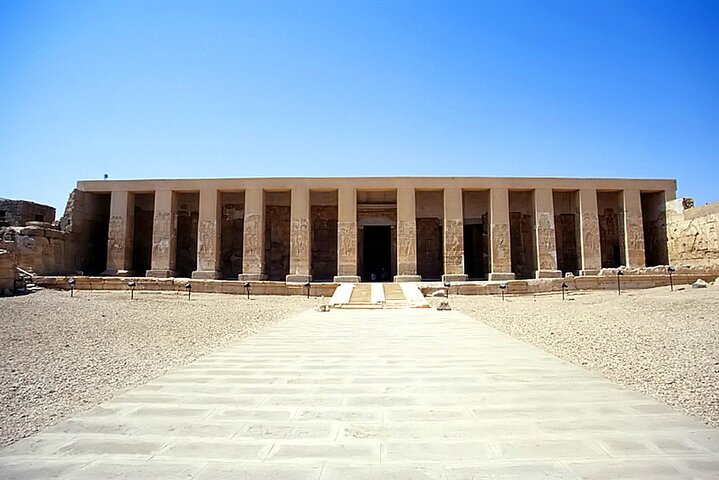
Abydos, known in ancient Egyptian as Abdju, was one of the oldest and most sacred religious centers in Egypt.
Located in modern Sohag Governorate, Abydos developed into an important cult center long before the great temples that visitors see today were constructed.
Its importance was closely connected with Osiris, the god who became one of the most important deities associated with death, resurrection, and the afterlife.
Ancient Egyptian tradition identified Abydos with the burial and resurrection traditions of Osiris.
As a result, the city became one of the most important pilgrimage destinations in ancient Egypt.
For Egyptians, visiting Abydos was not simply sightseeing.
It was a religious act.
Why Was Abydos Sacred?
The religious importance of Abydos goes back to the earliest periods of Egyptian history.
The area was already associated with royal burials during the Predynastic Period and Early Dynastic Period.
The royal tombs of the earliest kings at the Umm el-Qa'ab cemetery demonstrate the extraordinary antiquity of the site's funerary significance.
Among the most important early rulers associated with Abydos were kings such as Narmer, Hor-Aha, Djer, and Den.
The cemetery therefore provides essential evidence for the emergence of the Egyptian state and the development of royal funerary traditions.
Centuries later, the religious significance of Abydos was transformed and expanded through the cult of Osiris.
This created a remarkable continuity:
Abydos connected the earliest kings of Egypt with the later theology of resurrection and eternal life.
The Temple of Seti I
The most spectacular surviving monument at Abydos is the temple of Seti I, one of the great architectural masterpieces of the New Kingdom.
Seti I ruled during the 19th Dynasty, approximately in the 13th century BCE.
The temple was completed after his death by his son Ramesses II, although the monument is principally associated with Seti.
Unlike many Egyptian temples, the Temple of Seti I has an unusual L-shaped plan.
Its architecture includes courtyards, hypostyle halls, sanctuaries, chapels, and richly decorated walls.
The temple was dedicated to several major deities, including:
- Osiris
- Isis
- Horus
- Amun-Re
- Ptah
- Re-Horakhty
- Seti I himself
The arrangement of the temple reflects the complex religious landscape of New Kingdom Egypt.
It was not simply a monument to one god.
It was a carefully organized sacred environment in which different divine powers were connected through ritual.
The Famous Abydos King List
One of the most historically important features of the Temple of Seti I is the famous Abydos King List.
Carved on a wall within the temple, the list presents the names of numerous Egyptian kings in chronological sequence.
It is one of the most valuable historical records from ancient Egypt.
The list does not represent a complete modern-style chronology of every Egyptian ruler. Instead, it reflects a carefully selected royal tradition that emphasized legitimate kingship.
Several rulers were deliberately omitted, including some kings whose legitimacy was rejected by later Egyptian religious and political traditions.
This makes the list particularly interesting.
It is not simply a record of history.
It is also a statement about who ancient Egyptians believed belonged to the legitimate royal tradition.
The Osireion: A Monument of Mystery
Behind the Temple of Seti I lies one of Abydos' most enigmatic structures: the Osireion.
Constructed largely below ground level, the monument is associated with the funerary mythology of Osiris.
Its architecture is dramatically different from the conventional temple structures surrounding it.
Massive granite blocks form a central chamber surrounded by water channels, creating an atmosphere unlike almost any other monument in Egypt.
The monument's exact date and original function have been subjects of archaeological discussion, but its strong connection with the Osirian religious landscape of Abydos is unmistakable.
The Osireion demonstrates an important feature of Egyptian sacred architecture:
the physical environment itself could be transformed into a representation of the mythological world.
Water, darkness, stone, and underground architecture evoked the mysterious realm associated with death, regeneration, and the primeval waters of creation.
The Osiris Myth at Abydos
The importance of Abydos cannot be understood without the story of Osiris.
According to Egyptian mythology, Osiris was a divine king who was murdered by his brother Set.
His body was dismembered and scattered, while his wife Isis searched for his remains.
Through her magical powers and with the assistance of other deities, Isis restored Osiris.
Osiris became ruler of the realm of the dead, while his son Horus became the rightful heir to the Egyptian throne.
The myth expressed one of the fundamental ideas of ancient Egyptian religion:
death was not necessarily the end of existence.
The deceased could potentially achieve regeneration and eternal life.
Abydos became one of the most important places where this theology was experienced through ritual.
The Osiris Festivals
Abydos was famous for religious festivals connected with Osiris.
These ceremonies symbolically recreated episodes from the myth of Osiris.
Processions moved through sacred spaces while priests performed rituals representing the death, restoration, and resurrection of the god.
For participants, these ceremonies were more than theatrical performances.
They were sacred acts believed to renew the cosmic order.
The annual cycle of rituals connected the death and resurrection of Osiris with the renewal of nature and the eternal continuation of life.
This is one reason why Abydos became such an important pilgrimage center.
Pilgrimage to Abydos
Ancient Egyptians who could not be buried at Abydos could still seek a spiritual connection with the sacred city.
They placed votive stelae, offering objects, statues, and other commemorative monuments in or around the sacred landscape.
Some inscriptions record prayers and names of individuals who wished to participate symbolically in the cult of Osiris.
For this reason, Abydos became a place where ordinary Egyptians could leave behind evidence of their personal religious beliefs.
These objects provide archaeologists with something that royal monuments often cannot:
the voices and hopes of individuals.
Dendera: The House of Hathor
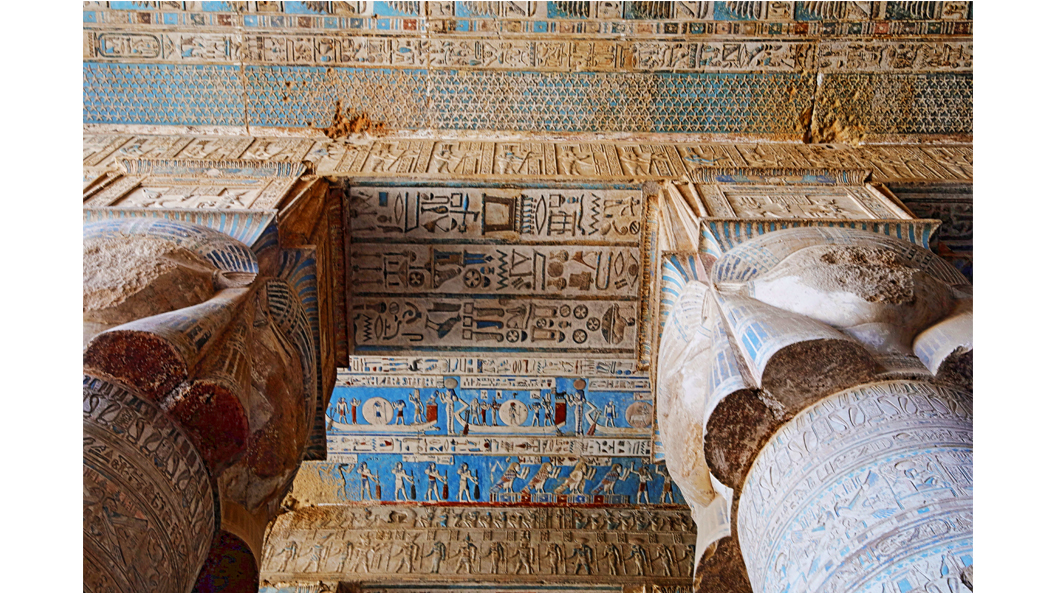
Travel farther south and another sacred landscape appears.
At Dendera, near modern Qena, stands one of the best-preserved temple complexes in Egypt.
The ancient Egyptian name of the city was Iunet, and its principal goddess was Hathor.
Hathor was one of the most complex goddesses in the Egyptian religious tradition.
She could be associated with:
- Love
- Beauty
- Music
- Dance
- Motherhood
- Fertility
- Joy
- Female power
- Protection
- The sky
- The sun
- The afterlife
Her cult therefore touched almost every dimension of Egyptian life.
The Temple of Hathor
The surviving Temple of Hathor at Dendera was constructed mainly during the Ptolemaic and Roman periods, although the sacred site itself was much older.
Construction and decoration continued over several centuries.
The temple contains an impressive entrance, monumental columns, hypostyle halls, sanctuaries, crypts, stairways, chapels, and roof structures.
Its walls are covered with reliefs and inscriptions depicting Egyptian gods, kings, queens, priests, rituals, astronomical imagery, and religious texts.
Despite its late date, the temple deliberately preserves many traditional Egyptian artistic and religious conventions.
This makes Dendera particularly valuable for understanding how ancient Egyptian religion survived and evolved during the Greco-Roman period.
The Faces of Hathor
One of the most recognizable features of Dendera is the use of Hathoric columns.
The capitals display the face of Hathor with her characteristic features and cow ears.
The goddess was strongly associated with the cow and with maternal protection.
The columns therefore transformed the architectural space into a visual expression of the goddess herself.
Visitors entering the temple would encounter the divine image repeatedly throughout the sacred complex.
Architecture and theology were inseparable.
The Famous Dendera Zodiac
Perhaps the most famous object associated with Dendera is the Dendera Zodiac.
The original astronomical ceiling relief was located in a chapel dedicated to Osiris on the roof of the temple complex.
It depicts the heavens using a circular composition containing constellations, planets, and zodiacal figures.
The Dendera Zodiac is particularly important because it demonstrates the interaction between traditional Egyptian astronomical concepts and the intellectual traditions of the Greco-Roman world.
The relief is generally dated to the Ptolemaic period, although the religious and astronomical traditions represented within it draw upon much older Egyptian concepts.
Today, the original zodiac is preserved in the Louvre Museum, while a reproduction remains at Dendera.
The Crypts of Dendera
One of the most fascinating aspects of the Temple of Hathor is its network of crypts.
These narrow chambers were incorporated into the temple's architecture and were used for the storage and ritual protection of sacred objects.
Some crypts are decorated with highly specialized religious imagery.
Their restricted spaces emphasize an important distinction within Egyptian temples:
not every sacred area was intended for public access.
The temple contained different levels of religious experience.
The outer areas were more accessible, while increasingly sacred spaces were reserved for priests and ritual activities.
The Sacred Lake and Temple Rituals
Like many major Egyptian temple complexes, Dendera included facilities necessary for priestly ritual.
Water was essential to temple life.
Priests performed ritual purification before entering sacred areas, and water was connected symbolically with creation and regeneration.
The temple complex therefore functioned as more than a place where people came to pray.
It was a carefully controlled religious institution with its own priests, rituals, sacred objects, offerings, and economic resources.
The Birth of Horus at Dendera
Dendera was also connected with the mythology of the birth and protection of the divine child.
Hathor's relationship with Horus formed part of the temple's religious theology.
The divine family could be understood through different local and national traditions, linking Hathor with motherhood, protection, and the renewal of divine kingship.
Ritual scenes throughout the temple emphasize the relationship between the gods and the Egyptian king.
The king appears before the deities performing offerings and receiving divine approval.
These scenes were not simply decorative.
They expressed the fundamental Egyptian concept that the king was responsible for maintaining Ma'at — the divine order of the universe.
The Sacred Union: Hathor and Horus
One of the most fascinating religious traditions associated with Dendera involved the annual journey of Hathor to meet Horus at Edfu.
The festival connected two major temples along the Nile and symbolically united divine powers.
Such festivals were important because ancient Egyptian religion was not confined to individual temples.
The gods could travel.
Sacred images could be carried in ceremonial boats.
Temples could participate in religious networks extending across large parts of Egypt.
The journey between Dendera and Edfu therefore demonstrates how Egyptian religious geography operated on a much larger scale.
Ancient Egyptian Temples Were Ritual Machines
A common mistake is to think of Egyptian temples simply as places where ancient people went to worship.
In reality, a major temple was an enormous religious institution.
It contained:
- Priests
- Sacred images
- Offering rituals
- Storage facilities
- Workshops
- Administrative spaces
- Economic resources
- Sacred texts
- Processional routes
- Ritual chambers
The temple was considered the earthly residence of the deity.
Every day, priests performed rituals intended to care for the divine image.
Food, incense, clothing, water, flowers, wine, milk, and other offerings could form part of the ritual system.
The purpose was ultimately to maintain the relationship between humanity and the divine world.
Abydos and Dendera: Two Different Paths to Eternity
Although Abydos and Dendera are different religious centers, they reveal complementary aspects of Egyptian belief.
At Abydos, the central themes are:
Osiris — Death — Resurrection — Afterlife — Eternal Life
At Dendera, the central themes include:
Hathor — Motherhood — Beauty — Music — Fertility — Protection — Cosmic Harmony
Yet the two traditions were not isolated.
Egyptian religion was interconnected.
Osiris, Isis, Horus, Hathor, Amun, Re, Ptah, and countless other deities could appear in different local traditions and theological systems.
The gods were part of a complex religious universe rather than a simple hierarchy.
The Importance of Abydos & Dendera for Archaeology
Together, Abydos and Dendera provide evidence for thousands of years of Egyptian religious development.
Abydos preserves evidence extending from the earliest dynasties through the Middle Kingdom, New Kingdom, and later periods.
Dendera demonstrates how Egyptian religious traditions continued into the Ptolemaic and Roman periods.
This chronological depth is extraordinarily important.
The temples show that Egyptian religion was not static.
It changed.
Old myths were reinterpreted.
New rulers adopted ancient traditions.
Foreign dynasties presented themselves using traditional Egyptian religious imagery.
And ancient theological concepts survived even as Egypt became part of the wider Hellenistic and Roman worlds.
Beyond the Pharaohs: Understanding Ancient Egyptian Belief
The greatest value of Abydos and Dendera is that they allow us to move beyond the familiar image of Egypt as a civilization of pyramids and mummies.
The monuments reveal a society deeply concerned with questions that remain familiar today:
What happens after death?
How does life emerge from death?
How can humans communicate with the divine?
How is the universe kept in balance?
Why does nature regenerate?
What makes a king legitimate?
How can the deceased achieve eternal existence?
These questions were embedded in the architecture, inscriptions, festivals, offerings, and rituals of the temples.
Abydos & Dendera: A Journey Through the Sacred Nile Valley
A journey to Abydos and Dendera is therefore much more than a visit to two archaeological monuments.
At Abydos, visitors enter the sacred world of Osiris, where royal burial traditions, resurrection mythology, and pilgrimage came together over thousands of years.
At Dendera, they encounter the magnificent sanctuary of Hathor, where music, motherhood, fertility, astronomy, kingship, and divine protection were expressed through one of Egypt's most beautifully preserved temples.
Together, the two sites reveal the extraordinary intellectual and spiritual complexity of Ancient Egypt.
They show that Egyptian temples were not merely monuments built in stone.
They were places where the ancient Egyptians believed that the boundary between the human and divine worlds could be crossed.
Enter the Sacred World of the Gods
The pyramids reveal the power of Egyptian kings.
The temples of Luxor reveal the grandeur of the New Kingdom.
But Abydos and Dendera reveal something deeper: the religious imagination that shaped Egyptian civilization itself.
At Abydos, the story of Osiris transformed death into the possibility of resurrection.
At Dendera, Hathor embodied the forces of life, beauty, motherhood, music, and cosmic protection.
Together, they tell a story that stretches far beyond individual pharaohs.
It is the story of a civilization that believed the universe was alive, that the gods were present within sacred places, and that rituals could help preserve the eternal order of creation.
To stand among the temples of Abydos and Dendera is to enter a world where architecture became theology, mythology became ritual, and the ancient Nile Valley became a sacred landscape inhabited by gods.
Discover Abydos & Dendera with Narmer Tours
For travelers fascinated by Ancient Egyptian religion, archaeology, temples, mythology, and sacred architecture, Abydos and Dendera are among the most important destinations in Egypt.
A journey through these sites offers the opportunity to explore:
Temple of Seti I • Abydos • Osireion • Osiris Cult • Abydos King List • Temple of Hathor • Dendera Zodiac • Hathor Cult • Ptolemaic Egypt • Ancient Egyptian Religion
Rather than following only the most famous monuments, a deeper archaeological journey reveals the religious traditions that connected Egyptian civilization across thousands of years.
Abydos and Dendera are not simply places to visit. They are places to understand Ancient Egypt.
To see Tour Itinerary click Here.
Book your Experience now:
🌐 Official Website
📧 info@narmertours.com
📞 WhatsApp:(+20) 01210136814
📱 Facebook | Instagram | TripAdvisor